Table of Contents
If you import ceramic toilets, the one-piece vs two-piece decision is not about looks. It is a procurement calculation that touches freight cost, breakage rate, installation labour, spare-part availability and per-container unit count.
This guide compares both designs using real OTOL catalogue dimensions and typical export shipping patterns. No marketing claims — just the numbers that affect your landed cost.
What is the structural difference?
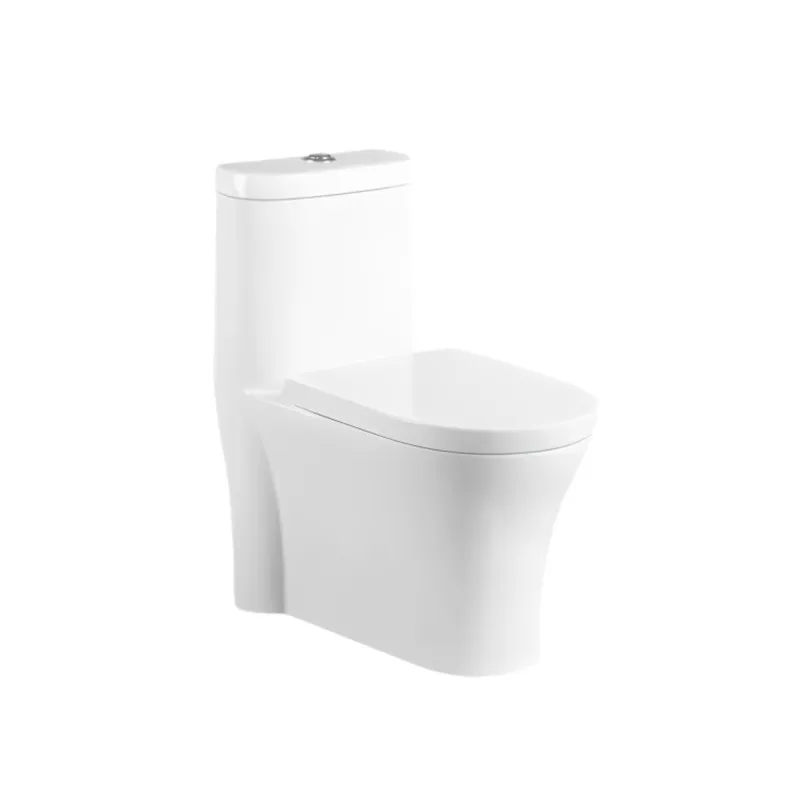
A one-piece toilet (OTOL T111 series) moulds the tank and bowl as a single ceramic body. There is no joint between tank and bowl, which eliminates a leak path and simplifies cleaning.
A two-piece toilet (OTOL T112 series) ships as two separate components — tank and bowl — that are bolted together during installation. This is the most common toilet format worldwide because it is easier to manufacture, pack and transport.
| Feature | One-Piece (T111x) | Two-Piece (T112x) |
|---|---|---|
| Body construction | Tank + bowl moulded as one unit | Separate tank and bowl bolted together |
| Typical weight | Heavier — single piece of ceramic | Lighter per box — two smaller boxes |
| Joints/leak points | None between tank and bowl | Gasket + bolts between tank and bowl |
| Cleaning access | Smooth exterior, no crevices | Crevice at tank-bowl join |
| Installation | Place and connect water | Assemble tank to bowl, then place and connect |
| Common rough-in | 250–300mm S-trap | 180mm P-trap / 250–300mm S-trap |
Freight volume: how many units fit a container?
Because one-piece toilets are a single rigid ceramic form, their packaging box must be large enough to enclose the full height of the assembled toilet. Two-piece toilets pack the tank and bowl in separate (or stacked) boxes that are shorter and can be nested more efficiently.
Take two real OTOL models as examples:
T111014 (one-piece): 680 × 370 × 760 mm single box T112013 (two-piece): 665 × 345 × 825 mm — but tank and bowl nest tighter, giving more units per layer
Approximate 20GP container estimate (standard practice):
| Configuration | Units per 20GP | Units per 40HQ |
|---|---|---|
| One-piece (T111 series) | 70–85 | 160–190 |
| Two-piece (T112 series) | 100–120 | 220–270 |
Two-piece toilets typically load 25–40% more units in the same container volume because the separate tank and bowl can be packed in alternating orientation. The exact count depends on carton design, inner packing (EPS foam vs pulp mould), and whether the seat ships fitted or separate.
Note: Container counts above are estimates based on typical export packaging for standard elongated-bowl models. Exact numbers depend on carton dimensions, pallet configuration and packing method. OTOL confirms per-SKU container loading details in the formal quotation.
Breakage risk: what the freight statistics show
Ceramic toilets are fragile freight. Industry handling data consistently shows that:
- One-piece toilets have a higher per-unit breakage rate in transit because a single impact can crack the tank-bowl connection area, which is unreinforced. A cracked one-piece is a total loss.
- Two-piece toilets have lower per-unit breakage because the tank and bowl travel in separate protective foam cavities. If one part arrives damaged, you replace only that component — not the entire unit.
Industry research from Guangzhou Sourcing on sanitary-ware LCL shipping reports that ceramic breakage rates are heavily influenced by packaging method, not just product design. EPS foam moulding for two-piece tanks can reduce impact transfer significantly compared to single-piece padding.
Practical takeaway for importers:
- If your warehouse can manage separate inventory for tanks and bowls, two-piece lowers your breakage write-off risk.
- If you sell direct to retail and want shelf-ready packaging, one-piece may justify the higher margin.
Installation: labour time and skill
Two-piece installation requires:
- Fitting the gasket between tank and bowl
- Bolting the tank to the bowl (two bolts, evenly torqued)
- Connecting the water supply line
- Mounting the toilet to the floor flange
Estimated labour: 35–50 minutes for a competent plumber.
One-piece installation skips step 1 and 2. The toilet arrives pre-assembled:
- Connect water supply
- Mount to floor flange
Estimated labour: 20–30 minutes.
For a hotel renovation (200 rooms) where each minute of labour is costed, the one-piece premium in purchase price may be offset by 10–15 hours of saved installation labour.
Replacement and spare parts
If a two-piece tank cracks, the homeowner or facility manager replaces only the tank. If the bowl cracks, only the bowl. The matching part number is available through the original supplier.
For a one-piece toilet, any crack in the ceramic — whether on the tank surface, the bowl rim or the base — means replacing the entire unit.
Which design suits which buyer?
| Buyer type | Better fit | Why |
|---|---|---|
| Hotel / multi-unit developer | One-piece | Faster install, fewer service calls, modern appearance |
| Distributor importing by the container | Two-piece | Higher unit density per container, lower breakage write-off |
| E-commerce retailer selling to homeowners | Two-piece (budget) / One-piece (premium) | Two-piece: lower landed cost. One-piece: fewer leakage complaints |
| Project tender with spec requirements | Depends on price and certification | Confirm model-level cUPC or WaterMark status in your market |
| OEM/ODM private-label buyer | Either | OTOL evaluates product scope and market requirements per project; see our private-label process guide |
What OTOL stocks in the T111 and T112 series
OTOL manufactures both one-piece (T111x) and two-piece (T112x) ceramic toilets in white vitreous china. All models use dual-flush washdown technology (3L/6L) and are available with 250mm or 300mm S-trap, and selected T112 models with 180mm P-trap.
| Model | Type | Dimensions (mm) | Flush | Rough-in |
|---|---|---|---|---|
| T111001 | One-piece | 725 × 395 × 755 | 3/6L dual | 250mm S / 180mm P |
| T111002 | One-piece | 710 × 420 × 785 | 3/6L dual | 250mm S / 180mm P |
| T111005 | One-piece | 660 × 360 × 760 | 3/6L dual | 250mm S / 180mm P |
| T111014 | One-piece | 680 × 370 × 760 | 3/6L dual | 250mm / 300mm S |
| T112001 | Two-piece | 620 × 365 × 820 | 3/6L dual | 250mm S / 180mm P |
| T112004 | Two-piece | 610 × 380 × 830 | 3/6L dual | 250mm S / 180mm P |
| T112012 | Two-piece (WaterMark) | 700 × 365 × 830 | 3/4.5L dual | 250/300mm S + 180mm P |
| T112013 | Two-piece (WaterMark) | 665 × 345 × 825 | 3/4.5L dual | 250/300mm S + 180mm P |
Prices, MOQ, sample route, lead time and packing are confirmed for the selected SKU, quantity and destination in the formal quotation.
For cUPC + ETL requirements on smart toilet models for North America, read our cUPC and ETL guide for US/Canada importers. For OEM/ODM private-label inquiries, see the step-by-step process.
The bottom line
There is no universal "better" design. The choice depends on whether you optimise for freight density and replacement cost (two-piece) or installation speed and seamless appearance (one-piece).
OTOL manufactures both types from the same ceramic line. If you are evaluating a project or a container order, contact our team with your market, target models and quantity — we will confirm the model match, certificate scope and commercial terms in writing.