Table of Contents
When importers ask us to quote basin faucets, the two decisions that change everything else are where the faucet mounts — deck-mounted on the basin or counter, or wall-mounted above it — and what the body is made of (solid brass or zinc alloy). Nail those two first, and the finish, cartridge and hole spacing fall into place. This guide walks through each so you can specify a faucet once and avoid rework.
Deck-mounted vs wall-mounted: match the faucet to the rough-in
Mounting type drives the rough-in your customer must prepare, and it is the most common source of order mistakes.
Deck-mounted (basin or counter mounted)
- Mounts through holes drilled in the basin, vanity top or counter.
- Water supply runs below the deck to flexible hoses; the faucet sits on the finished surface.
- The easiest to install and service, and the default for residential, retail and most renovation work.
Wall-mounted
- The rough-in sits inside the finished wall, so the supply, mounting and mixer body live behind the tile.
- Needs blocking and a precise rough-in height before the wall closes; service access is behind the wall.
- Frees the counter and is common in hotels, apartments and minimalist bathrooms.
| Factor | Deck-mounted | Wall-mounted |
|---|---|---|
| Rough-in location | Holes in basin or counter | In-wall, before tile |
| Installation difficulty | Lower | Higher; needs blocking and precise height |
| Service access | Below the deck | Behind the wall |
| Counter space | Uses deck space | Frees the deck |
| Typical projects | Residential, retail, renovation | Hotels, multifamily, minimalist |
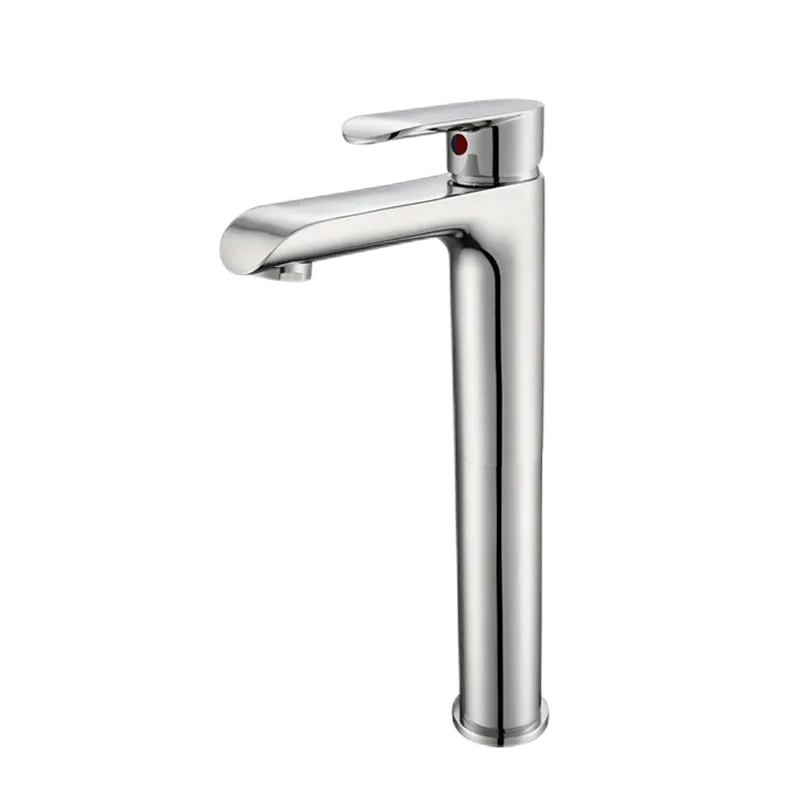
A deck-mounted single-hole example is the solid-brass T211090 basin tap, offered in chrome and matte black with a 5-year warranty in its spec sheet. For wall-mount jobs, the T211103 wall basin mixer is a solid-brass chrome option built for space-saving layouts.
What's inside matters: solid brass vs zinc alloy
The body and the waterway are where long-term reliability is won or lost.
- Solid brass body — strong and corrosion-resistant; this is what a mid-market basin faucet should be. The OTOL basin faucet range is built on solid brass bodies.
- Zinc alloy handle — common even on brass-body faucets, and normal. The handle is a low-wear part, so a zinc handle on a brass body is fine; the body and waterway are the parts that leak and corrode.
- Zinc alloy body — the sign of a cheap faucet. It is softer and more prone to failure than brass, so check the body material, not just the finish.
The cartridge is the part that fails first
On a single-lever basin faucet the cartridge is the wear part, so it deserves its own line in the spec.
- The common industry size is a 35 mm ceramic disc cartridge — quarter-turn, drip-free, and widely replaceable.
- Check that the cartridge is a standard replaceable part so service means a cheap cartridge swap, not a whole new faucet.
- OTOL single-lever basin faucets list a 35 mm ceramic disc cartridge in their specs, and the three-hole mixer lists quarter-turn ceramic disc cartridges.
Hole configuration: single-hole, 4-inch centerset, 8-inch widespread
The faucet has to match the holes already drilled (or being drilled) in the basin or counter.
| Configuration | Holes | Typical spacing | Fits |
|---|---|---|---|
| Single-hole | 1 | — | Single-lever basin faucets |
| Centerset | 3 | 4 in (102 mm) | Compact vanities |
| Widespread | 3 | 8 in (203 mm) | Larger counters, classic three-piece |
The three-hole T211250 mixer is a widespread example: its spec lists standard 8-inch (203 mm) hole spacing.
Finish: chrome vs matte black — ask how the black is applied
- Chrome — electroplated, hard, easy to clean, and the safest default for high-use and commercial projects.
- Matte black — the look is popular, but durability depends on process. Ask whether it is PVD (physical vapor deposition, more scratch-resistant) or electroplated black before committing a large order.
OTOL basin faucets are offered in chrome and black or matte black finishes across the range.
Lead-free compliance for US importers
In the United States, faucets and fittings that contact drinking water fall under the Safe Drinking Water Act and the Reduction of Lead in Drinking Water Act. The wetted surfaces must meet the lead-content requirement, commonly demonstrated by certification to NSF/ANSI 372.
Importers — not just manufacturers — can be liable for plumbing products sold as lead free that are not certified. The US EPA has published a compliance advisory for manufacturers and importers, and NSF summarizes the Safe Drinking Water Act requirements and the NSF/ANSI/CAN 372 technical requirements.
We verify material composition and compliance-document status for the exact faucet model and destination before quotation — ask for the document scope that covers your market rather than assuming a blanket lead-free claim.
What to confirm before you order
- Rough-in type: deck or wall, and whether a wall install has blocking behind it.
- Number of holes and center spacing: single-hole, 4 in, or 8 in (203 mm).
- Body material: solid brass (avoid zinc alloy bodies).
- Cartridge: 35 mm ceramic disc, standard replaceable part.
- Finish, and for matte black the application process (PVD vs electroplated).
- Supply hose length and thread standard for the destination market.
- Lead-free or local plumbing compliance for the destination.
- MOQ, lead time and freight: confirmed in the quotation, not assumed.
If you are building a full bathroom or project schedule, this pairs with our basin selection guide and our per-room fixture list for hotels and multifamily. Send your rough-in and hole layout through the contact form or browse the bathroom faucet range and we will match the faucet, finish and cartridge to the project before you commit a container.